Built to Last: How Hardware Encoders Continue to Adapt to Changing Broadcast Demands
The broadcasting sector has always been cyclical. Shifts in business models, evolving standards, and tightening budgets continue to redefine how content is produced and delivered. In this environment, attention often gravitates toward what is new. Yet many of the industry’s most dependable building blocks have evolved quietly in the background, adapting without demanding constant replacement.
Hardware encoders fall firmly into this category. While software-based solutions attract headlines, dedicated encoding hardware continues to underpin many live production, contribution, and distribution workflows across Europe. Its appeal lies less in novelty and more in predictability: consistent performance, controlled latency, and operational stability in environments where failure is not an option. Increasingly, these platforms combine that reliability with software-driven evolution, extending useful lifecycles and protecting capital investment.
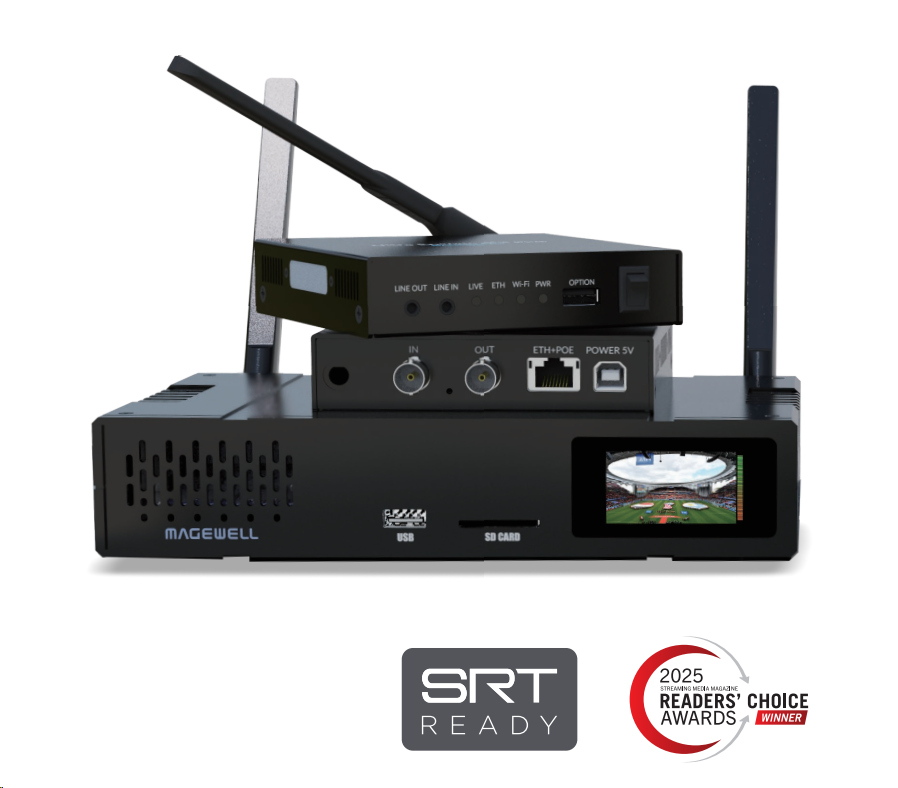
Magewell’s Ultra Encode range offers a useful example of this approach. Rather than being defined by a single application, the platform has gradually expanded through firmware updates to address a wider set of broadcast and ProAV use cases. Available in multiple models, Ultra Encode has found adoption in live streaming, remote contribution, and IP-based production scenarios, particularly where system integrators value straightforward deployment and long-term maintainability.
Flexibility has been a defining characteristic of the platform from the outset. Built on hardware designed for continuous operation, Ultra Encode devices are firmware-upgradable, allowing new protocols and workflows to be introduced over time. Support for technologies such as NDI®, Zixi, TVU’s ISSP, RTMP, SRT, and Wowza reflects the reality of European broadcast environments, where hybrid infrastructures and mixed-vendor ecosystems are common rather than exceptional.
As the industry moves into 2026, development priorities for hardware encoding platforms are increasingly shaped by interoperability and operational choice. Upcoming updates to the Ultra Encode line reflect this trend, with planned support for RIST addressing demand for open, low-latency contribution over unmanaged networks. Updates to NDI 6.3 and other device management tools are similarly aimed at giving broadcasters and integrators greater freedom in how systems are monitored, configured, and controlled—without locking workflows into a single ecosystem.
Ultra Encode will be shown in operation at ISE 2026 in Barcelona, offering broadcasters and system integrators an opportunity to evaluate how dedicated hardware encoders continue to adapt to modern IP-centric workflows, while retaining the stability that has long made them a trusted component of broadcast infrastructure.